Isabel Demo: Decision Support Plus Natural Language Processing
Isabel,
used even by skilled diagnostician himself Dr. Gurpreet Dhaliwal, is a diagnostic decision support tool. The company works with Enhanced Medical Decisions to utilize its natural language processing technology. Isabel CEO Don Bauman and CEO of Enhanced Medical Decisions Marlene Beggelman demonstrate how the partnership works.
Leave a comment -
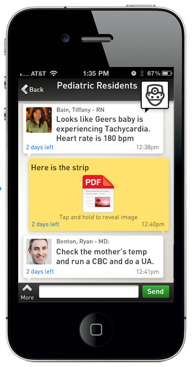 Is it acceptable for physicians to text patient orders to the hospital? No, answered the Joint Commission in a 2011 statement. But that doesn’t mean that physicians don’t do it, despite the commission’s concerns that texting makes it difficult to verify the sender’s identification and that texts aren’t archived for validation purposes. Physicians still text because it is time-efficient, convenient, and they’re used to doing it in their everyday lives.
For an idea of the kinds of scenarios in which texting makes sense, watch TigerText’s demo video. At one point a nurse asks the doctor to come down to the ER to look at a patient’s wound for signs of infection. Instead, the doctor asks for a picture message of the wound, and from the image he’s able to see that there’s no infection. As doctors’ workflows evolve with the times, TigerText aims to provide doctors with a secure way to carry out this type of communication.
“My brother who is 50 likes to say that basically nothing has changed on day-to-day health care communication since he was a resident,” CEO of TigerText Brad Brooks said of his brother, Andrew Brooks, MD, who is an advisor to the company. However, today the TigerText Pro solution is used by 350 enterprises, and the company’s announcement this week that it opened its API to third party developers means that its service could start to change more rapidly.
TigerText’s now open platform could allow physicians to start using text messaging to communicate with organizations outside of the hospital. For example, imaging labs and diagnostic companies will be able to send lab results from their facilities to physicians via TigerConnect, which Brooks describes as a conduit. They can also see when their files were delivered to and viewed by the physician, saving the labs the time of having to track doctors down by phone.
Brooks talked about a couple of other use cases made possible by the open API. TigerText has already integrated with AMiON, a physician schedule manager. The integration allows doctors to use their mobile device or computer to type in queries like “Dr. Green” or “4 p.m.” to find out when a specific doctor is on call or to find out who’s on at a particular time.
Continue reading →
HHS announced their 2013 agenda to lower costs and improve quality of care with the use of health information technology. The agenda focuses on the development of health information exchanges and the improvement of data liquidity.
A study published in JAMIA found that logs of the search activities of populations of computer users can contribute to drug safety surveillance. Internet-user information searches may provide early clues to adverse drug interactions.
UPMC partnered with Oracle to offer a cloud-based identity management solution to small and midsized healthcare providers. UPMC will help healthcare users implement Oracle Identity Management applications, which will help smaller practices manage identity and security issues at a more affordable price.
AMC Health announced that they will offer a money-back guarantee on their program to reduce hospital readmissions for high-risk patients. The guarantee offers a full refund if readmissions don’t decline by at least 10 percent within 90 days of deployment using a proven interactive voice response (IVR) program with case management initially deployed by the Geisinger Health Plan (GHP) and AMC Health.
A study published in the journal Circulation found that home blood pressure (BP) monitoring led to greater BP reductions, superior BP control, and higher patient satisfaction than usual care. The study was conducted using Heart360, an online tool to track and manage heart health.
Alexander Tsiaras, founder & CEO of TheVisualMD, won the 2013 Satava Award for the development and use of advanced technology for dynamic visualizations of the human body. TheVisualMD offers health information as a rich visual experience.
Wrist-based health tracker, Basis, raised $11.5M in Series B funding. Key investors include Mayfield Fund, DCM, and Norwest Venture Partners. The company also expanded its advisory board to include healthy living expert, Deepak Chopra and Esther Dyson, a technology analyst.
AT&T’s mobile health (mHealth) solution will automatically connect people in distress to medical assistance by tracking their location in real time. The solution, part of AT&T’s complete suite of remote patient monitoring (RPM) care, demoed at HIMSS 2013.
EHR vendor Allscripts acquired dbMotion, a healthcare interoperability software maker, and Jardogs, a patient engagement software vendor. The acquisitions are a part of Allscripts’ plan to invest about $500M this year to expands its current product line.
According to ONC’s latest data brief, hospital adoption of EHR system more than tripled since 2009. The brief also stated that adoption of EHR technology to meet Meaningful Use objectives grew substantially from 72% in 2011 to 85% in 2012.
Leica Biosystems, provider of digital pathology systems, collaborated with Dell to create a scalable medical cloud network. This network allows Chinese physicians access to U.S. healthcare organizations for real time, expert review of pathology cases.
Matthew Holt visited Kareo, CareCloud, and Enhanced Medical Decisions on the floor Wednesday at HIMSS13.
Robert Fortini is chief clinical officer of Bon Secours Medical Group, a health system with several hospitals throughout the eastern United States. Its hospitals across Virginia are “eyeballs deep” in their preparations for Accountable Care Organizations, which is part of the reason they began using Phytel population health management technology. Speaking from HIMSS13 Fortini tells the story of how he kept one heart failure patient, who had a history of ER visits, from consistently needing emergency care to instead seeking primary care.
 WebMD’s newest iPhone application has more than 600 articles, about 130 quizzes, 23 videos, and dozens of other pieces of content. Think about those numbers and then think of all the resources an expectant mother juggles during her pregnancy. With its latest app for pregnant women and women trying to conceive, WebMD aimed to create the most comprehensive prenatal care tool out there.
“When people think about WebMD typically, they think about medical information and content,” Todd Zander, WebMD’s vice president of mobile and emerging media, said. So the creators built more than just educational materials into the app. WebMD Pregnancy also allows users to keep a personal journal in order to record milestones like the moment a woman finds out she’s pregnant and her baby shower event.
The free app was born after its sister app, WebMD Baby, which was released last year. It was certainly created with WebMD’s users in mind, as the site’s largest audience group includes moms in their 30s. The company recently ran a survey across its site for a week in February, during which 865 moms and moms-to-be responded to questions about their mobile use. More than 40% of them said that since they became pregnant, they started using their phones more frequently to search for information or to share photos.
Including the latest release, WebMD has seven apps in the App Store and also has applications for Andriod, Kindle Fire and the iPad. Among those are the WebMD app, which contains information on a number of medical topics, as well as condition-specific apps like WebMD Allergy. It’s no surprise that the company has developed two of its apps for new parents since its regular audience is largely made up of this demographic. In addition, there’s a growing effort by many companies to put information where it seems mothers are looking ― on their mobile devices. Sixty-one percent of moms have smartphones, Zander said. In recognition of high usage statistics like these, this year the Consumer Electronic Show even had a whole exhibit dedicated to MommyTech.
 The delivery of health care is dominated by individual providers, such as physicians and nurses, and large institutions, mainly hospitals and nursing homes. It feels like the patient is the little character that sits in the corner of Tom Toles’ Pulitzer Prize-winning editorial cartoons in the Washington Post waving a flag – saying in high pitched voice, “I am here! I am here!” or “I can help! I can help!” The larger picture seems always to be focused on big discussions in health care – how systems need to change, how providers need to change, how new models will transform care. As a nation, we’ve really neglected that all-important person in the corner who has the most crucial input of all. The patient, according to Leonard Kish, a health IT consultant, is “the blockbuster drug.”
In a recent New Yorker article, Dr. Oz is quoted as saying, “Ultimately if we want to fix American medicine we will need skeptical and smart patients to dominate.” Several years ago when I was having back problems, my physician said he wanted to talk with me about getting an MRI. I asked whether he would do anything different after seeing the MRI results. He paused… and then said, “good question” and “no.” Sometimes “just saying no” is the best response. All times it is valuable to have patients engaged in their care.
In the latest issue of Health Affairs, there is evidence on why patient engagement and activation are very smart things to do. Judy Hibbard and Jessica Greene reviewed over 100 articles and concluded that activation (which is one aspect of engagement) is linked to better care experiences and improved outcomes. In another article, they and Valerie Overton examined over 33,000 patient encounters finding that patients with the lowest activation levels had significantly higher billed costs.
The Robert Wood Johnson Foundation’s Aligning Forces for Quality initiative engages those who provide care, pay for care and receive health care in improving quality of care within their communities. This program is featured in this issue of Health Affairs which describes how patient engagement is playing out in places as diverse as south central Pennsylvania, Maine, Oregon, and Humboldt County, CA. It also points out that we need more data, more quantifiable research to help us understand ways we can start moving systematically toward a culture that respects the role of the patient AND knows how to involve patients in the most effective ways.
Continue reading →
 It’s that time of year again. In 24 hours, the Health 2.0 team will be converging - with the rest of the (hip) tech world - in Austin, TX. Before you pack up your Ray-Bans and fixed-gear bikes for the trip, be sure to add two events onto your calendar:
Sensor Technologies: The Future of Health?
Monday, March 11 - 3:30PM
Our very own Jean-Luc Neptune will be onstage at the Sheraton to moderate a future-facing chat between three of the sensor community’s heaviest hitters. David Van Sickle (Reciprocal Labs), Lama Nachman (Intel), and Mark Winter (Xprize) will be sitting down to talk sensors, data, and what we can look forward to tomorrow and ten years from tomorrow.
Get the details and add us to your schedule at SX Schedule.
Health 2.0′s SXSW Code-a-thon
Friday, March 8 - 2:00PM
It wouldn’t be Interactive Week without a roomful of entrepreneurs and nerds getting together to score some free money innovate and solve problems!
The official SXSW Code-a-thon will be hosted at the Sheraton and sponsored by BodyMedia. Swing by on Friday to build the next big thing in health and wellness, then head down to 6th Street with your team to celebrate!
SX Schedule has a map and more info for you.
As always, be sure to holler at a playa when you see me on the streets (we’ll have awesome swag to hand out)!
Emmi Solutions is a patient engagement company, but their more than ten years in the business sets them apart from most other companies in the same realm at HIMSS13. When Emmi began, physicians didn’t have a financial incentive to invest in their patients’ outcomes, so Emmi first tried to appeal to doctors’ concerns about medical malpractice. It developed education programs for patients to watch before a surgery in order to avoid preventable problems during. Emmi CTO David Pearah describes how the company’s approach has evolved since Accountable Care Organizations have changed physicians’ priorities.
 A recent study by Boston Children’s Hospital and Mayo Clinic found that a staggering 29.3% of children with ADHD experience the disorder well into adulthood. High School and College students with ADHD face the intimidating challenge of entering a less-structured environment upon graduation. While ADHD medicine helps, there is a critical need for technologies that help manage behaviors and encourage medication adherence. The Shire ADHD Transitions Challenge is offering $150,000 in total prizes for technologies that will azid young adults and help them manage the transitions between high-school and college as well as between college and the work force.
Phase I of the challenge focuses on ideation and closes in less than two weeks on March 17, 2023. Five submissions will be awarded $5,000 based on the quality and viability of their idea. Phase I requirements include:
1. Mock-up or drawing of concept
2. 5-page written document explaining the proposed application
Phase II of the challenge will involve the development of working applications proposed in Phase I of the competition. Submissions for Phase II are due August 18th. The top three submissions will receive $100,000, $20,000, and $5,000, respectively.
Join us in finding a solution to this growing problem by spreading the word about the challenge (click to tweet). Learn more about how you can get involved here!
Verizon will introduce the first national service enabling doctors to securely exchange medical records no matter what computer system they use. The product, known as Secure Universal Message Services, will cost between $10 and $60 a month per user for doctor’s offices and hospitals and will allow providers to share data, texts and e-mails while still meeting U.S. privacy standards.
Six EHR companies - Cerner, McKesson, Allscripts, athenahealth, Greenway Medical Technologies and RelayHealth - announced their formation of the CommonWell Health Alliance to promote interoperability of electronic health records. The Alliance will be a collaborative effort of suppliers focused on achieving data liquidity between systems, in compliance with patient authorizations. The Alliance is a step in the right direction when it comes to interoperability, and the move may even be credited, in part, to patient and clinician demands for interoperable EHRs and their associated benefits.
Wolters Kluwer Health announced today at HIMSS13 the release of the UpToDate Anywhere mobile app, an anytime/anywhere, comprehensive, evidence-based, clinical decision support tool. UpToDate Anywhere also offers back-end tools for healthcare IT administrators to streamline user registration and on-going user management. UpToDate Anywhere Subscriber Manager is a web-based tool for ambulatory group practices that allows administrators to add users, upload user groups and manage access efficiently.
Office of the National Coordinator for Health IT (ONC) is now accepting applications for potential membership for the new Food and Drug Administration Safety Innovation Act (FDASIA) Workgroup until March 8, 2013. The FDASIA is responsible for providing expert input on issues and concepts identified by FDA, ONC and FCC, in order to inform the development of a report on an appropriate, risk-based regulatory framework pertaining to health information technology including mobile medical applications that promotes innovation, protects patient safety, and avoids regulatory duplication.
Deloitte Consulting, LLP, and Intermountain Healthcare, a Utah based hospital system, formed a five year collaboration to use big data for providing healthcare analytics to the medical industry. The alliance will draw upon Intermountain’s digital data records since 1970, and aims to incorporate data from other leading health systems as well.
San Diego-based electronic medical record maker CliniComp International Inc. developed Essentris, a fetal heart rate monitoring mobile application. The app allows physicians to remotely monitor patients and their babies during labor. Daughters of Charity Health System, a six-hospital network in California, adopted the program systemwide, after a successful clinical evaluation at one of their San Jose locations.
The Robert Wood Johnson Foundation announced a second Call for Proposals in the field of behavioral economics. RWJF is seeking ideas that will help them better understand how to discourage the consumption of low-value health services — those that provide more harm than benefit or which provide only marginal health benefits. In addition to improving health outcomes, this knowledge could contribute to lowering health care costs for us all. Behavioral economics is an area of study in which the Foundation has recently begun to invest.
Athenahealth, a provider of cloud-based EHRs, practice management, and care coordination services, proposed a Health Information Technology (HIT) ‘Code of Conduct’. The Code calls upon the health information industry, particularly electronic health record (EHR) vendors, to abide by five principles related to data portability, patient safety, provider freedom of choice, and Meaningful Use. The HIT Code of Conduct is a response to recent statements by National Coordinator for Health IT, Dr. Farzad Mostashari.
Dell is partnering with Red Hat, Intel, and VMware, to open a dedicated center where hospitals can test and deploy a new option for running EPIC Systems’ electronic health records software on Red Hat Enterprise Linux. The hospitals can test their applications on a variety of Dell server and storage options, test configurations for end-user computing, perform cross-functional testing of other optimized solutions, and interact with all the primary third parties involved in a Linux deployment. The announcement was made at HIMSS 2013.
PathCentral, a cloud technology company, launched Digital Pathology Network, the first comprehensive online information exchange and digital consultation forum for global pathology community. The network allows physicians to upload case files using digital images for pathologists to review and render critical consulting diagnoses on both- global and domestic real-time basis. The company made the announcement at the 102nd United States and Canadian Academy of Pathology (USCAP) Annual Meeting, in Baltimore.
Aetna introduced a new business unit brand called Healthagen, a portfolio of innovative and growing businesses that tackles the fundamental needs of greater value, coordination and transparency in health care. Healthagen unifies Aetna’s population health management solutions and health information technologies from businesses that include ActiveHealth Management, iTriage and Medicity. Healthagen also develops new businesses, while Accountable Care Solutions (ACS) from Aetna combines Healthagen capabilities to deliver integrated population health management, advanced technology and health plan services.
← Older posts Newer posts →


 Idea for a guest post? Get in
 Health 2.0 TV